A heavy wool coat can sag on a narrow wire hanger, while a padded parka may strain a weak hook. The right hanger must support the garment at its shoulders and remain stable on the closet rod. Small details matter: shoulder width, a reinforced neck, a smooth finish, and a sturdy bar. There is no single “best” hanger for every coat. Wet fabric, bulky insulation, and uneven weight can change what works.
The U.S. Environmental Protection Agency’s Advancing Sustainable Materials Management: 2018 Fact Sheet estimated that 17 million tons of textiles entered the U.S. waste stream that year, with 11.3 million tons landfilled. Those figures cover textiles broadly, not coats alone, but they underscore why keeping garments in usable condition matters. ASTM D5034 measures textile fabric breaking strength; it does not certify a hanger’s safe load. Check a maker’s stated capacity instead, and treat unsupported weight claims cautiously. A hanger can look solid and still bend.
How to choose the right hangers for heavy coats comes down to fit, construction, and credible specifications. This guide compares wood, reinforced plastic, and metal designs, with practical checks you can make before hanging a costly coat. No hanger can fix a cramped closet. Still, the right one can help a coat keep its shape.
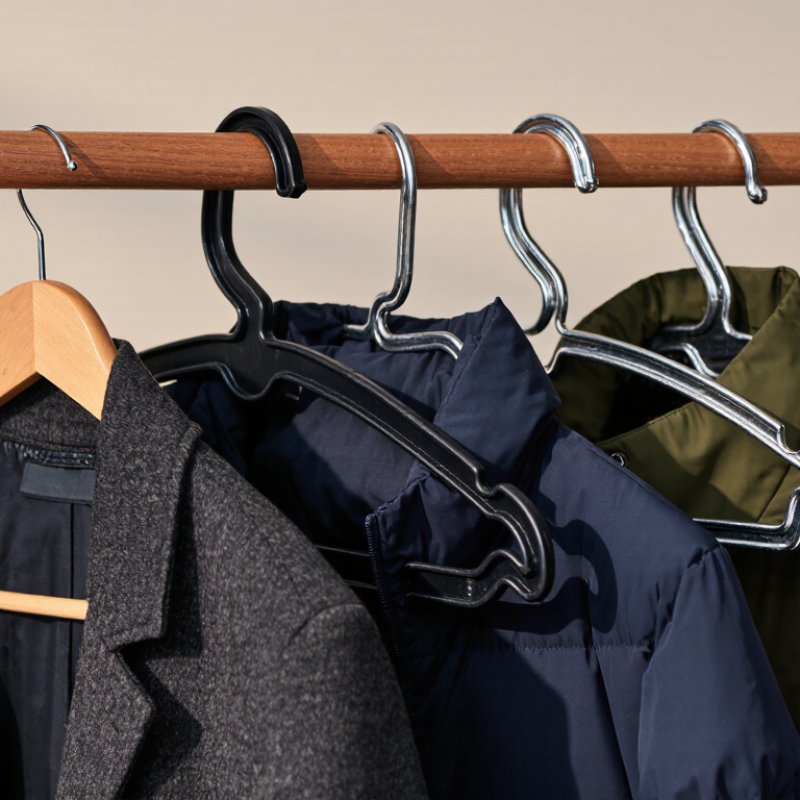
A heavy winter coat needs more than a hook that looks sturdy. A thin wire hanger can bend under its weight and leave sharp shoulder dents. Choose a solid wooden or reinforced plastic hanger with broad, gently curved shoulders. That shape spreads the load and helps preserve the coat’s structure. Fit matters. The hanger should support the shoulder seams without poking past them or letting the fabric droop. A few centimeters too narrow can make a difference.
Check the hanger’s stated load capacity, especially for long wool coats or damp outerwear, which can weigh more than expected. The hook should feel firmly attached, and the crossbar should not wobble when lifted. A smooth finish helps prevent snags on wool, lining, or knit cuffs; rough edges are easy to miss in a shop. Small detail, big annoyance. Non-slip shoulder ridges can help, though they may catch delicate linings. There is a trade-off: a very thick hanger supports well but can crowd a small closet. A quick fit check with the coat is more useful than choosing by appearance alone.
Wood hangers feel substantial and spread a coat’s weight across broad shoulders, helping preserve its shape. But wood is not uniformly strong. The USDA Forest Products Laboratory’s Wood Handbook (FPL-GTR-282, 2021) explains that wood strength varies with species, grain direction, and moisture. A damp closet or a knot near the hanger’s neck can therefore matter. A little frustrating, but true.
Steel offers a slim profile and high strength, while aluminum is lighter and resists corrosion. For a useful benchmark, ASTM A36/A36M specifies tensile strength of 400–550 MPa for A36 steel. That figure applies to the specified steel, not automatically to thin hanger wire; thickness and joint design also affect real-world performance.
Plastic hangers are light and often inexpensive, yet their capacity depends on resin, molding, and shape. Check for a thick hook-to-shoulder junction and flex the hanger gently before trusting it with a heavy wool coat. That matters.
I would not judge strength by appearance alone: a wide wooden hanger may support a coat well, but a cracked neck can fail without much warning.
What Is the Best Hanger for Heavy Coats?
How Hanger Shapes Support Different Coat Types
A heavy coat needs more than a thick hanger; its shape should match the shoulders. For wool overcoats and structured trench coats, choose a broad, gently curved hanger that reaches close to the shoulder seams. This spreads the coat’s weight instead of pulling at one small point. The shoulders should look supported, not stretched outward. That matters.
Padded or contoured hangers can help delicate fabrics keep their shape, while a sturdy, wide wooden hanger often suits dense winter coats. Check that the crossbar feels solid if you plan to hang trousers or a removable liner there. A narrow wire shape may leave dents in soft shoulders, especially when a coat stays hung for weeks. For lighter, unstructured coats, a slimmer hanger can be enough, provided it does not bend under the load.
I still find hanger choice easy to overthink. A broad shape is not automatically right if it extends beyond the coat’s shoulder seams; that can create bumps rather than support. Look at how the coat hangs after a day: are the shoulders smooth, and does the fabric fall naturally? If not, try a different width or curve. Heavy coats vary, and the best fit may take a little adjustment.
| Hanger Type | Shape and Support | Best Suited Coat Types | Advantages | Considerations |
|---|---|---|---|---|
| Wide, contoured wooden hanger | Broad, curved shoulders help distribute weight across the coat’s shoulder area. | Heavy wool overcoats, long winter coats, and structured topcoats. | Helps preserve the garment’s shoulder shape and provides firm support. | Choose a width that fits the coat; an overly wide hanger can stretch the shoulders. |
| Heavy-duty broad-shoulder plastic hanger | A molded, wide profile supports more of the shoulder than a thin hanger. | Everyday insulated jackets, padded coats, and medium-weight outerwear. | Lightweight and easy to clean; broad designs can offer useful support without much bulk. | Plastic strength varies by design. Avoid narrow or flexible versions for very heavy coats. |
| Padded or fabric-covered hanger | Soft, rounded shoulders cushion the garment and reduce contact with hard edges. | Delicate wool coats, dress coats, and garments prone to shoulder marks. | Gentle on fabrics and useful for maintaining a smooth shoulder line. | Check that the inner frame is sturdy enough for the coat’s weight; padding alone does not ensure support. |
| Shaped suit hanger | Contoured shoulders and a substantial crossbar support the upper garment and can hold trousers. | Structured dress coats and tailored overcoats. | Supports the shoulder line and keeps a matching outfit together. | Some suit hangers are designed for lighter garments; select a robust, wide model for a heavy coat. |
| Thin wire hanger | Narrow profile concentrates the coat’s weight on a small area. | Lightweight garments or short-term use, rather than heavy outerwear. | Takes up little closet space. | Can distort shoulder shapes or leave pressure marks; generally not a good choice for heavy coats. |
Practical tip: For most heavy coats, start with a sturdy, wide, contoured hanger that matches the garment’s shoulder width. Actual weight capacity depends on the hanger’s materials, construction, and condition.
What Is the Best Hanger for Heavy Coats?
Choosing the Right Hanger Size and Weight Capacity
For a heavy winter coat, hanger size matters as much as its stated weight limit. Choose a shoulder span close to the coat’s own width. If the hanger is too narrow, the fabric may sag; if it is too wide, its ends can press against the seams. A broad, contoured shape helps distribute weight. Check the maker’s capacity, and leave a margin instead of treating the maximum as a daily target. A damp coat can be surprisingly heavy.
Tips: Check the coat’s care label and the hanger’s stated load limit. Place the coat evenly, with both shoulders sitting fully on the hanger. If it bends or creaks, switch to a sturdier option.
A solid wood or reinforced hanger may suit a bulky coat, but material alone does not prove strength. Ratings can also be listed in different ways, so read the product details carefully. For a long, heavy coat, check that the hanger supports its shoulder structure without stretching the fabric. No rating? I would be cautious. It’s easy to focus on thickness and overlook how the hanger is built.
For a heavy coat, choose a sturdy, wide-shouldered hanger that fits the coat’s shoulder seams. The bars show representative widths within common sizing ranges; actual dimensions vary. Width alone does not indicate weight capacity, and there is no universal hanger load rating. Check the hanger’s stated capacity and make sure it exceeds the coat’s weight.
A heavy coat needs a hanger with broad, shaped shoulders and enough strength for its weight. A sturdy wooden or reinforced hanger can help prevent shoulder points from forming, while a narrow wire hanger may let dense fabric sag. Check the hanger’s weight guidance when available, and look for cracks, loose joints, or sharp edges. Small details matter. A smooth finish is less likely to snag wool or lining.
Good storage starts before the coat goes into the closet. Empty the pockets, fasten the coat loosely, and let damp fabric dry fully on a wide hanger. Brush off surface dust with a soft clothes brush; avoid forcing a tight cover over a coat that is still moist. Give garments space so air can move between them. Keep the closet away from direct sunlight and persistent dampness, and use a breathable cover for seasonal storage. Check the coat and hanger every few months. I’ve found that even a strong hanger can bend over time, especially when several heavy garments crowd one rail. Don’t assume it will last forever.
Choose broad, gently curved shoulders. They spread the coat’s weight and help prevent sharp shoulder dents.
The shoulders should support the coat’s seams without poking past them. A few centimeters can matter.
Check the stated load capacity, hook attachment, and crossbar. Lift the hanger gently; it should not wobble.
No. Wood strength varies with its type, grain, moisture, and defects. A crack near the neck matters.
Steel can be strong, while aluminum is lighter and resists corrosion. Wire thickness and joint design still affect performance.
Look for a thick hook-to-shoulder junction and flex it gently. Appearance alone can fool you.
They can keep a coat from slipping, but may catch delicate linings. A small trade-off.
Yes. Thick shoulders support well but take up space. Try the hanger with the coat before choosing by appearance.
The best hanger for a heavy coat combines strength, a supportive shape, and a suitable fit. Sturdy wood, reinforced plastic, and durable metal can all provide reliable support when designed to hold substantial weight. A broad, contoured shoulder area helps preserve a coat’s shape, while different styles may suit structured wool coats, bulky parkas, or lighter outerwear. How to choose the right hangers for heavy coats depends on matching the hanger’s width and weight capacity to the garment, with enough room to prevent shoulders from slipping or becoming misshapen.
For lasting support, check that hangers are free of cracks, bends, or weak joints, and avoid exceeding their recommended capacity. Leave space between coats so they can hang naturally and air out, and store them in a dry, uncluttered closet. These simple choices help protect both the hanger and the coat over time.

URneat Furnish